Detainers: Abloy Disc Principles
By abandoning vertical springs and individual pins entirely, rotating disc detainers represent the gold standard of high-security mechanical isolation.
Invented in Helsinki in the early 20th century by office machinery repairman Emil Henriksson, the disc detainer cylinder relies on an assembly of flat, rotating metal washers separated by thin spacer plates. Housed inside a precision-machined core, these discs feature semi-circular central cutouts through which a semi-cylindrical key passes.
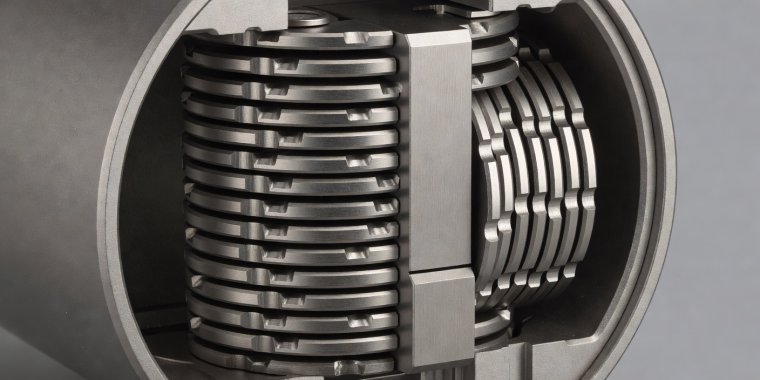
How Disc Rotation Unlocks the Sidebar
In standard rest mode, the notched perimeters of the internal discs are scrambled randomly. Running down the length of the cylinder is a hardened steel sidebar—a rectangular or semi-circular bar that rests halfway inside the inner core and halfway inside a slot in the outer housing shell. Because this sidebar spans both the moving cylinder and the static housing, the cylinder cannot turn.
The operational sequence unfolds mechanically in three steps:
- Angle Translation: The key has stepped diagonal cuts angled at specific degree increments (typically 0°, 18°, 36°, 54°, 72°, and 90°). As the key is inserted and turned, each cut rotates its corresponding disc to a precise angle.
- True Gate Alignment: When all discs are rotated to their correct angles, a series of rectangular notches on their outer perimeters—called true gates—align to create a single uniform, continuous channel beneath the sidebar.
- Sidebar Cam Collapse: Continued rotation of the key forces the sidebar against angled walls in the housing, pushing the bar inwards into the newly aligned true gate trough. With the sidebar fully seated inside the discs, the entire core rotates freely to throw the deadbolt.
Why Disc Detainers Defeat Pin-Picking Tools
Standard picking tools rely on individual pin feedback under tension. In a disc detainer, standard tensioning fails because the core cannot transmit binding friction to the discs until rotational tension is applied through one designated disc or a specialized tensioning sleeve. If an attacker applies tension through the first disc, they may lose the ability to freely read and manipulate the subsequent discs.
To pick a disc detainer, a technician must operate a complex two-piece tool (often called a disc manipulator) featuring a hollow outer shaft that tensions the cylinder and an inner calibrated needle that individually locates and turns each disc. High-security discs counter this attack by integrating false gates: shallow notches carved alongside the true gate. When picked under tension, the sidebar drops partially into a false gate, catching the disc in an immobile trap and giving tactile feedback indistinguishable from a genuine opening.
No Springs, No Bumping
Because the discs rotate entirely via mechanical key contact without spring assistance, bumping vibrations produce zero physical displacement. Bumping a disc detainer is mechanically impossible.
Extreme Environmental Tolerance
Without delicate coils or narrow pin chambers, disc detainers excel in harsh environments—unaffected by dirt, mud, sand, freezing temperatures, or road salt corrosion.
Disc Blocking Systems (DBS)
Modern evolutions like the Abloy Protec and Protec2 systems introduce a Disc Blocking System (DBS). This mechanism mechanically deadlocks the discs together horizontally the moment rotation begins, preventing an attacker from manipulating individual discs once tension is established. This renders traditional disc-picking tools ineffective, maintaining its position among the world's most attack-resistant mechanical lock designs.